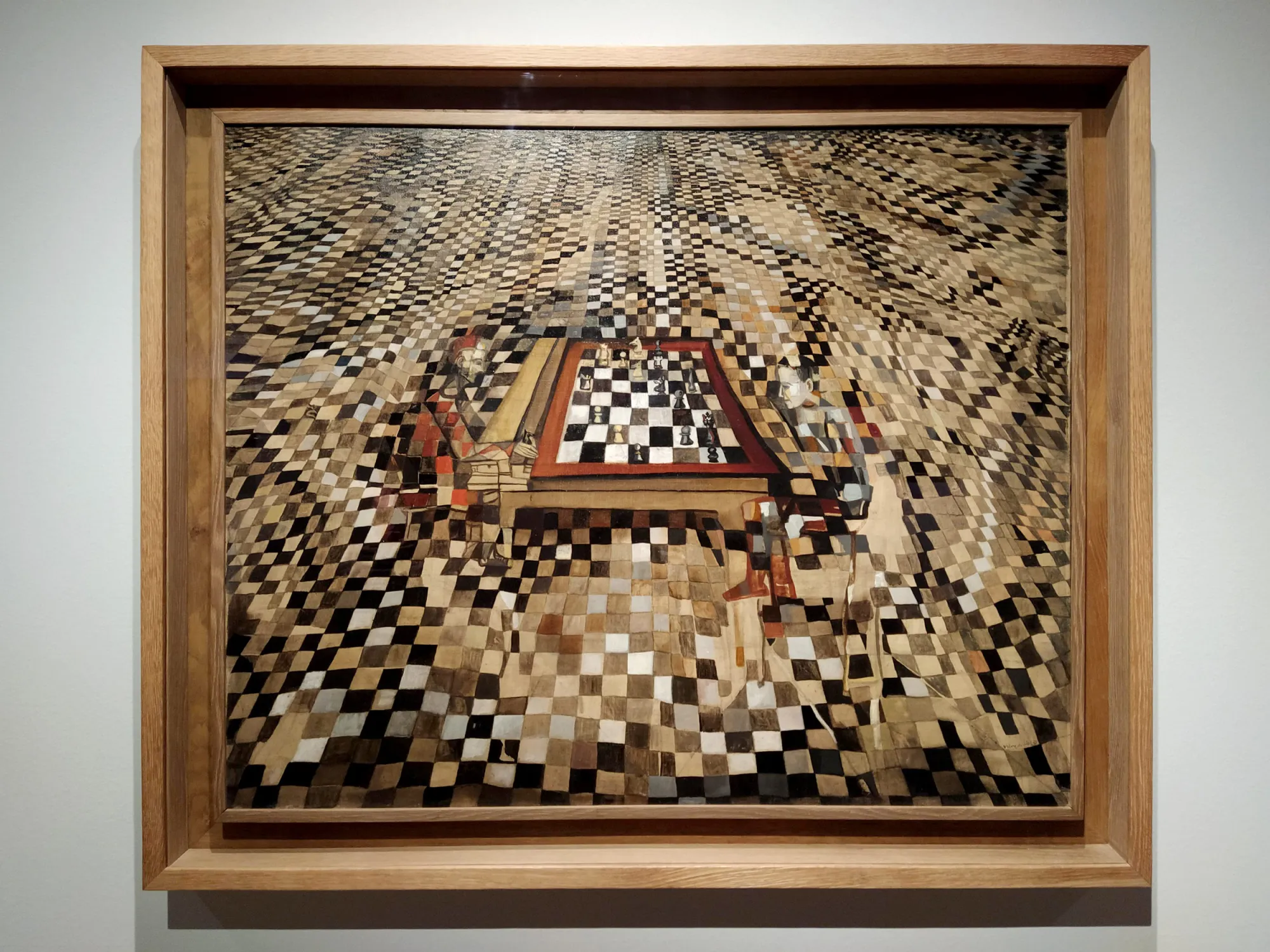
La partie d'échecs, 1943
Vieira da Silva: The Different Periods of Her Work
Scroll down
05 October 2026
From her training in Paris to her final paintings, a journey through the discoveries and changes that shaped Vieira da Silva’s work.
In Vieira da Silva’s paintings, libraries seem to stretch beyond the canvas, while the lines of cities lead the eye along uncertain paths. Through works from different periods, we explore six stages of her career to understand how this visual language evolved and how certain themes returned over the decades. Along the way, we also look at her prints and the places in Portugal where her work can be seen.
When we look at many of Vieira da Silva’s paintings, we begin by following a line or recognising what might be a street or a bookshelf, until overlapping planes make our bearings less certain. That moment of hesitation draws us in, inviting us to linger as we look for a way through the forms.
In the work of Maria Helena Vieira da Silva (Lisbon, 1908 - Paris, 1992), a small rectangle can help build an immense space, while a figure almost disappears among the lines surrounding it. As we follow her career, we discover how these relationships change and how light finds different ways through the painting, sometimes within the same decade.
The six periods below help us trace those changes, although their boundaries are approximate. Since themes return and different lines of enquiry coexist, placing a work within her career means considering how its space is constructed and the technique used, as well as the relationship between figures and colour. The palette may offer clues, but it cannot establish a date on its own.
1. Paris and the first discoveries (1928–1934)
When Vieira da Silva arrives in Paris in January 1928, she is nineteen and has already studied drawing, painting and modelling in Lisbon. Her training in the city begins with sculpture, which she studies with Antoine Bourdelle at the Académie de la Grande Chaumière before attending classes with Charles Despiau.
This choice proves short-lived, as she leaves sculpture behind in 1929 and turns towards painting through her studies with Dufresne, Waroquier and Friesz. She also attends Fernand Léger’s classes and begins learning printmaking with Stanley William Hayter, broadening an education that will include Roger Bissière at the Académie Ranson from 1932.[^1][^2]
Beyond the classroom, travel and exhibitions offer further discoveries. During a visit to Italy in the summer of 1928, she develops an interest in Sienese painting, particularly the Lorenzetti frescoes, while that same year she is drawn to Bonnard’s colour relationships and chequered surfaces. These references are joined by the work of Joaquín Torres-García, which the artist herself would later recall first encountering in 1929.[^2][^3]
Even a bridge becomes part of this education of the eye. In 1931, the structure of Marseille’s transporter bridge offers her a new experience of architecture and urban space, at a time when figures and interiors are beginning to become arrangements of lines and planes of colour in her painting. The grid gradually gains importance among several approaches to composition.
It is also during these years that she marries the Hungarian painter Arpad Szenes, in 1930. Three years later, Jeanne Bucher organises her first solo exhibition, associated with the gouaches for the children’s book Kô et Kô, beginning a relationship with the gallery that will last for decades.[^1]
2. Games and the paths of the eye (1935–1939)
In the second half of the 1930s, space becomes increasingly unsettled as lines of perspective intersect and planes seem to shift. The eye may recognise a figure, only to find it almost absorbed into the surrounding structure.
It is worth spending some time with Le Jeu de cartes, from 1937, where small squares and elements of the game set the surface in motion. Made in oil and graphite on canvas, this painting helps us understand the importance of the period, as does La Scala ou Les Yeux, from the same year.[^4]
Cards and game boards offer rules while leaving room for chance, and the players enter this relationship through a composition in which the position of each element seems to depend on the others. It is this meeting of order and unpredictability that leads the Guggenheim to read these images as a metaphor for the game of life itself.[^4]
The grid has a curious effect here, organising the painting while making the eye hesitate. Although it creates depth, its competing directions make it difficult to settle on a single viewpoint, opening up possibilities that Vieira da Silva will continue to explore for many years.
3. Exile: Lisbon and Rio de Janeiro (1939–1947)
With the outbreak of the Second World War, Vieira da Silva and Szenes leave Paris and spend time in Lisbon before departing for Brazil in June 1940. They settle in Rio de Janeiro, where they remain until 1947, although distance from Europe does not keep the war out of her painting.[^1]
Some works from this period have been grouped under the description “themes of panic”. In Le Métro, a gouache on card from 1940, a crowd shelters in the Paris Métro, and the closeness of the bodies makes that collective experience of danger palpable. Four years later, in História Trágico-Marítima ou Naufrage, the human presence is bound to catastrophe and the struggle to survive.[^5][^6]
Looking at these images, it is worth noticing how space is occupied, because this is also where their tension takes shape. In certain compositions, the proximity of the figures and the fragmentation of forms almost make us feel the difficulty of finding a way through. That sense of confinement can emerge through restrained colour ranges or vivid contrasts, without a single palette defining the period.
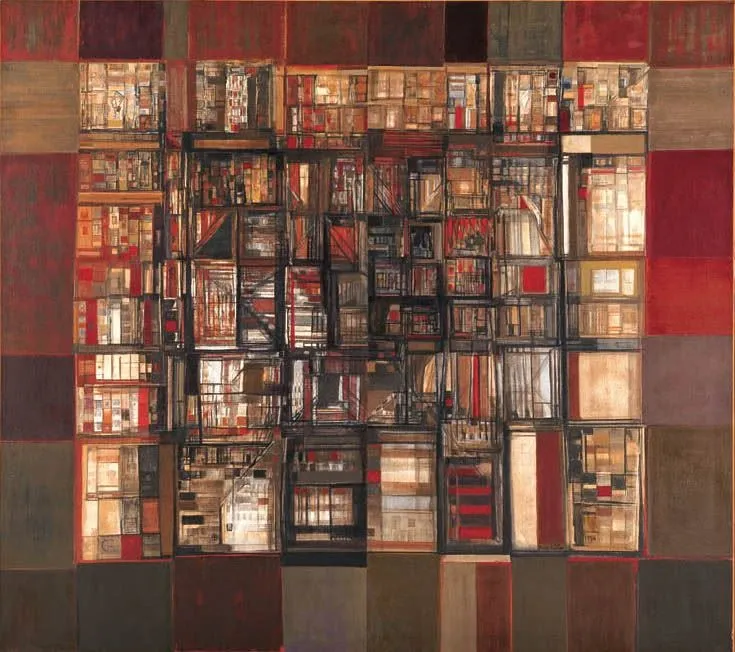
Meanwhile, earlier lines of enquiry continue. La Forêt des erreurs (1941) and La Partie d’échecs (1943) extend her interest in unstable space and the ways it can be organised, showing how games and labyrinths remain present.[^7] The war helps us understand the tension in these paintings, but does not exhaust their meaning, just as their titles guide our reading without replacing close attention to the image itself.
4. Returning to Paris (1947–1959)
Vieira da Silva returns to Paris in March 1947, followed shortly afterwards by Szenes. The presentation of works from her years in Brazil at the Galerie Jeanne Bucher forms part of a period of growing recognition, with important precedents.
In 1937, Hilla Rebay had acquired one of her paintings for the Guggenheim collection, and in 1943 the artist had taken part in Exhibition 31 Women, organised by Peggy Guggenheim in New York. From the late 1940s, acquisitions by the French state add to this international recognition.[^1][^8][^9]
Libraries become a more prominent subject in her painting from 1949, joining cities, studios, railway stations and worksites. Through the repetition of small elements, Vieira da Silva constructs spaces that seem to extend and change direction, resisting an immediate reading.
It is easy to understand the desire to find affinities for these places. In its discussion of Bibliothèque, from 1949, the Centre Pompidou draws parallels with Borges’s labyrinths and Piranesi’s Prisons, while other interpretations see the small rectangles as recalling Portuguese azulejo tiles.[^2][^10] These associations enrich our experience of the paintings, provided they remain possible readings rather than a single explanation for their structures.
Throughout the 1950s, her painting takes quite different directions. The ethereal quality of L’Oranger (1954) and the atmospheric shimmer of The Town (1955) show how space is already opening up and contours softening during this decade. In Londres (1959), meanwhile, deep blue and a firm structure coexist with hazy areas, creating an image that feels dense and indistinct at once.[^11][^12]
Among greys, ochres, whites and blues, architecture can become more concentrated or lose definition. Just when we think we have found a stable construction, a less clearly defined area may draw the eye elsewhere.
5. Between structure and light (1960s and 1970s)
International recognition grows during the 1960s, with honours including the International Grand Prize for Painting at the São Paulo Biennial in 1961. Five years later, Vieira da Silva becomes the first woman to receive the French government’s Grand Prix National des Arts.[^13]
In her painting, however, this maturity continues to allow for different rhythms. While the grid in La Bibliothèque (1966) retains a strong presence, L’Aire du vent, from the same year, features heavy lines and a palette of greys and blues. In other compositions, brushwork and colour relationships open up the space, making its boundaries less definite.[^2][^11]
These differences help explain why the two decades cannot easily be described as a continuous move towards softer painting. Strong structures persist alongside atmospheric effects and, within a single work, a dense area may meet a more open one. A line need only break off or continue in an unexpected direction for the path of the eye to change.
Themes also return, as they do in Bibliothèque en Feu, from 1974, which revisits the library and shows how titles with a dramatic charge remain part of her work.[^14]
Her work in other media also has earlier roots, since Vieira da Silva had been illustrating since the 1930s and had designed the sets for Arthur Adamov’s La Parodie in 1952. In 1954, she had also won the tapestry design competition for the University of Basel.
In the following decades, these explorations continue through new commissions, including the tapestry Janela, woven in Portalegre in 1969. The stained-glass windows for the church of Saint-Jacques in Reims, commissioned in 1966, are completed in 1976.[^2][^11] Following these works allows us to discover how her ideas find other surfaces and extend beyond the canvas.
6. The final years: looking at light and empty space (1980s–1992)
In some late paintings, the structure opens up gaps or loses definition, while in others forms accumulate and remain densely packed. Light therefore becomes a particularly interesting guide through the composition, whether it passes through it or interrupts what had seemed continuous.
Light can also create tension, as in L’Issue lumineuse (1983–1986), where a luminous opening meets the resistance of the forms gathered around it.[^15] Le Retour d’Orphée (1982–1986), by contrast, reveals a darker side, and the Gulbenkian relates its density to Szenes’s illness and his death in 1985.[^14]
This reading connects the painting with the experience of loss, without turning the entire output of these years into the expression of a single state of mind. Across the period, we find both the dispersal of the grid and the concentration of forms, so dematerialisation remains one possibility among others.
Public projects also continue. In 1983, the Lisbon Metro commissions the decoration of Cidade Universitária station, which includes Manuel Cargaleiro’s translation into azulejo tiles of Le Métro, the gouache from 1940. The station opens in 1988, the same year that a major Vieira da Silva retrospective is presented at the Gulbenkian and the Grand Palais in Paris.[^5][^13]
Through this move into tile, an image created during the war finds a different scale and a new place in the city.
A detail worth noticing in her prints
Vieira da Silva’s prints offer another route into her work, encompassing lithography and screenprinting as well as etching and engraving with a burin. Libraries and cities reappear, along with gardens and labyrinthine spaces, although similarities between subjects do not always mean that the works were made around the same time.
This distinction matters because a print may return to a composition created well before its edition. The screenprint Projet Tapisserie Université Bâle, from 1983, for example, revisits the design associated with the 1954 tapestry competition, bringing back a composition from almost thirty years earlier.[^16]
It is therefore useful to distinguish between the date when the composition was created, the making of the printing matrix and the edition to which the impression belongs. A resemblance to a painting from a particular period may guide research, but needs to be considered alongside the available documentation.
For further study, an essential reference is the catalogue raisonné published by Skira in 1994, by Guy Weelen and Jean-François Jaeger, compiled by Virginie Duval and Diane Daval Béran. For prints, Vieira da Silva: les estampes, 1929–1976, published in 1977, should be supplemented with documentation on editions produced after the period it covers.[^17]
Where to find her work in Portugal
In Lisbon, the Arpad Szenes-Vieira da Silva Museum, in Amoreiras, brings the two artists’ careers into focus through its works and documentary material. A visit can be complemented by an exploration of the collection at CAM, the Gulbenkian’s modern art centre, which includes paintings and prints by Vieira da Silva, among them História Trágico-Marítima ou Naufrage, from 1944. As the selection on display changes with the programme, a work’s presence in the collection does not mean it is always on view.[^6][^12]